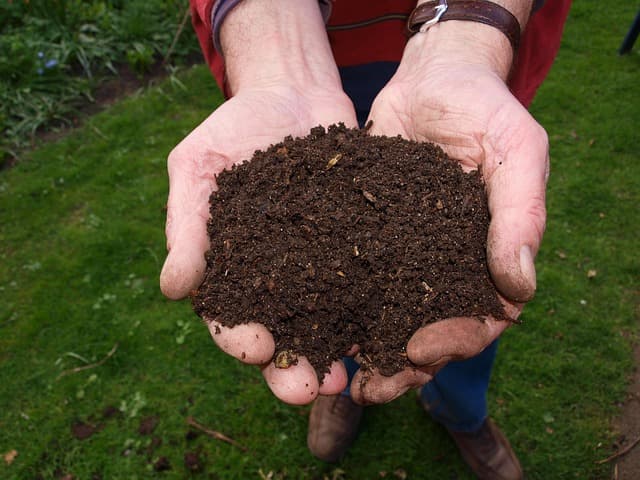
The process of turning a compost heap into compost was not “invented” by us. Nature itself has worked out this procedure, and all we have to do is to provide conditions favorable to it. An abundance of organic material, nitrogen (in one form or another) to “ignite” the heap, sufficient size to support combustion, air, moisture, bacteria. And no matter how the compost pile is made – underground or above ground, two years or two weeks, in a pit or in a box, in the form of a hay pile or a strip in a trench – only the above conditions are essential. Provide them, and the compost will be there.
The size of the pile, you need to consider the ratio of heating the pile to cooling it by the outside environment. The heap can be helped by, for example, covering it (but, not cutting off the oxygen!). Hay, straw and soil are good for this. However, the decisive value is still the size of the heap. Practice shows that a meter in the cube is not enough, and a hundred and twenty centimeters is just right. Access to air is usually recommended to provide shaking the pile at least once a week. This is a good way. It greatly accelerates the maturation of the compost.
Moisture is also an important factor. An ideal heap should resemble a wrung-out sponge. Of course, if water is available, it is not difficult to achieve this by watering the heap from time to time. If all hope is for rain, then the “rudder” is the shape of the roof top. In summer it should be flat, and in winter – streamlined. About the provision of leaven has already been discussed, for this is suitable soil or old compost.
Choosing a location. There are many factors to consider when choosing a location. An improperly ripened (e.g. too wet) pile may give off an unpleasant odor. In addition, it can look unnatural, and there is a natural desire to get it out of sight.
Preparing the base. The top layer of soil is removed and laid outside the boundaries of the site. If the place for it is low, waterlogged, it is not necessary to remove the soil. On the contrary, it will be necessary to dig a trench around the heap in the process of forming it, and the excavated soil will overlayer the heap.
Covering the heap. The bottom layer should be made airy. Rough materials are good – thin branches of trees and bushes, sunflower and topinambur stalks (but not corn), reed tubes. It is possible not to shred them – this will preserve their ventilating qualities. Then you need to lay green and brown ingredients and soil (or old compost) in the proportion of 8:8:1. This means that on a layer of green (wet) materials 15-20 centimeters thick should lie the same layer of brown materials and a 3-5 centimeter layer of soil. The materials should be mixed as much as possible (the stronger, the better). Only the proportion is important. The height of the heap is determined by the stock of materials 120 centimeters at most.
Formation of the heap. The finished heap should be watered, covered with a layer of soil about 5 cm thick, covered to reduce evaporation and heat loss, and planted with plants appropriate at the moment.
Accompaniment. From time to time you should look at the heap to see if there is enough moisture in the heap and if everything is in order. If the mass inside the heap is wet, dirty, smelly, the heap should be ventilated (turned over or mixed by adding dry materials and protected from rain), if the mass is dry, it should be watered and covered to preserve moisture. One to two weeks after the start of burning, you should put worms in the heap. If the finished heap reveals layers that are stacked, it is necessary to “wind it up” and in the future more thoroughly pulverize large particles, and use these enclaves in the next heap.
It is useful to monitor the temperature in the heap. Heat kills weed seeds, some bacteria and spores. Seeds and pathogens can live at 50 degrees for several weeks, at 55 degrees – a few days, at 60 – a few hours. A higher temperature is not necessary: useful microorganisms can die at this temperature. You can regulate the temperature by watering and turning the pile. Waiting for the beginning of cooling of the heap, you can run in it earthworms.
Turning is especially useful for large heaps, as it provides them with oxygen, as it is necessary to maintain the necessary bacterial growth and significantly shortens the composting time. If you turn the compost every two to three days and strictly keep it moist to the level of a squeezed sponge, you can have compost in two to three weeks. However, if it doesn’t “burn” and can be tolerated, relax. There is no harm without good.
Environmental improvement. Composting vegetable garden and kitchen waste is a very important process for the environment. Waste is and will be waste, and it is necessary to get rid of it. Chemical means (incineration) are both loss of organic matter and damage to the environment. Physical means (landfill) – all the same loss and pollution of the environment and only biological means – composting – allow to get rid of waste, and not to harm the environment, and save resources, return to the earth waste in a form in which they can be effectively used by plants.
Drought protection. The high permeability of compost-rich soil protects plants from drought. Such soil absorbs moisture like a sponge. Moisture accumulates in the films enveloping the pellets. The films on humus pellets can hold up to two kilograms of water per kilogram of humus! Unbelievable figures! Fantastic! And at the same time, the moisture of the films is constantly available to the root hairs of the plants, so that on humus-rich soil plants can withstand quite long dry periods.
Nutrients – as required by the plants. Compost as a fertilizer is good primarily because it is rich in many nutrients and enzymes that plants need. And the more diverse the ingredients in the compost heap, the more types of nutrients will be in the compost. The basic elements – nitrogen, phosphorus, potassium are usually presented in ratios from 0.5:0.5:0:0:5 to 4:4:4:4. As a rule, compost also contains all micro and diffuse elements necessary for plants. They are essential for plant growth and generation, although they are needed in small plants.
Increased plant resistance. Compost miraculously increases the resistance of plants to diseases and pests. This is primarily because strong plants grow on organic-rich soil.